Introuduction
Picture a Monday morning where three different employees ping HR: one needs their latest pay stub, another wants to check how many vacation days they have left, and a third needs to update their home address after moving.
None of these requests are complicated, but each one pulls someone on the HR team away from more meaningful work to look something up and respond.
This is exactly the gap employee self service software was built to close. Instead of routing every routine request through HR, it gives employees direct, secure access to their own information, so they can find answers themselves in seconds rather than waiting on a reply. This article breaks down what employee self-service software actually is, what it lets people do, and why it has become such a foundational piece of modern HR technology.
Table of Contents
Point 1 : What Employee Self-Service Software Actually Is
A Simple Definition
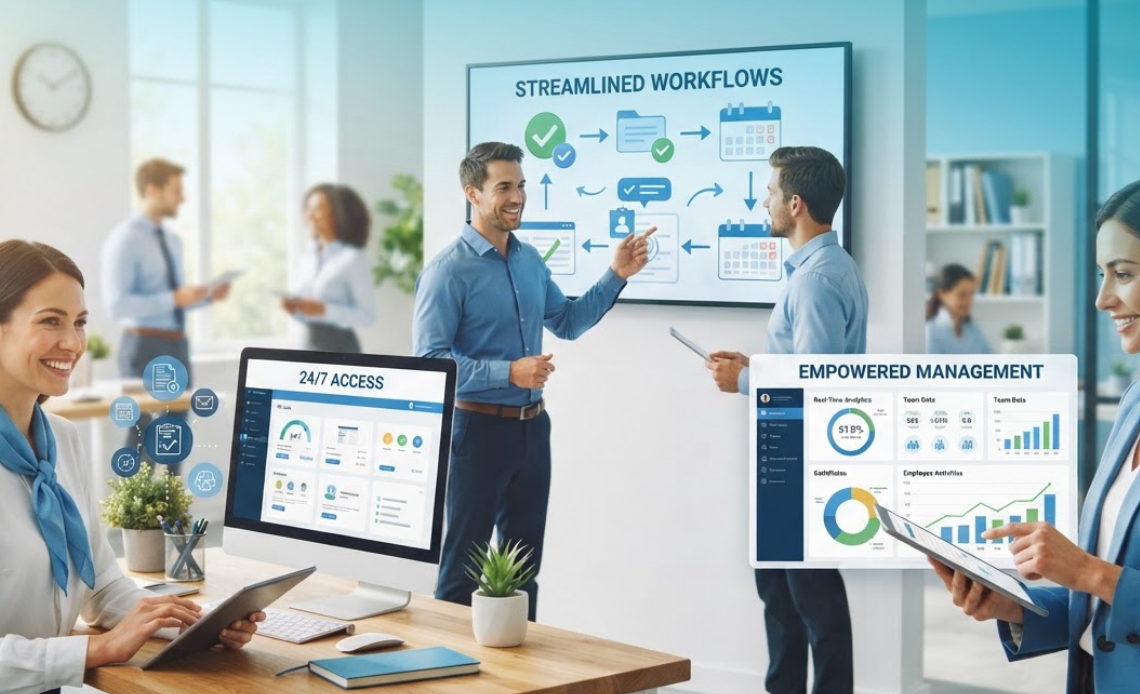
Employee self-service software, often shortened to ESS, is a secure, web or mobile-based platform that lets employees access and manage their own HR-related information directly, without needing to go through a manager or an HR representative for every request. Think of it as a personal HR dashboard: log in, and you can see your pay history, update your own details, or submit a request, all without sending a single email.
Where ESS Fits Inside a Broader HRIS
Employee self-service software is rarely a standalone product. In most cases, it’s a module built into a broader HR information system (HRIS) or human capital management (HCM) platform, sitting alongside payroll, benefits administration, and performance management. The self-service layer is simply the employee-facing window into that same underlying system, so when an employee updates their address through the portal, that change flows directly into the central HR database rather than living in a separate, disconnected tool.
Point 2 : What Tasks Employees Can Handle Without HR
Personal Data, Payroll, and Benefits Management
At its core, ESS software typically lets employees view and download pay stubs and tax documents, update personal information like address or emergency contacts, and review or adjust their benefits elections during open enrollment. Some platforms also let employees manage direct deposit details themselves, cutting out a task that used to require a form and a wait.
Leave Requests, Scheduling, and Document Access
Beyond payroll and personal data, most ESS platforms handle time-off requests and approvals, shift or schedule visibility, and access to company policies and HR documents. Employees can submit a vacation request, see their remaining balance, and get a manager’s approval, all inside the same portal, without a single back-and-forth email.
Point 3 : Why Employee Self-Service Software Matters for Modern HR Teams
Reducing Repetitive HR Requests and Administrative Load
The time savings here aren’t hypothetical. A study conducted by Ernst & Young and cited in SHRM’s analysis of self-service technology examined 41 individual HR tasks and found that the average cost of a manual data entry transaction, one handled by an HR staff member, was $4.39, with labor costs accounting for nearly all of that total. Shifting these transactions to employee self-service represents a direct, measurable reduction in administrative cost for every routine request removed from HR’s plate.
Improving Data Accuracy and Employee Experience
There’s also a data quality benefit that’s easy to overlook. When employees update their own address, banking details, or emergency contacts directly, the information tends to be more current and accurate than when it passes through an intermediary, since the person entering the data is the one who actually knows it’s correct. On top of that, giving employees 24/7 access to their own records, rather than making them wait for business hours, generally improves how employees experience HR as a whole, turning it from a bottleneck into something that simply works when they need it.
Employee Self-Service Software vs Traditional HR Requests: Quick Comparison
| Factor | Employee Self-Service Software | Traditional HR-Mediated Requests |
|---|---|---|
| Availability | 24/7, any device with login access | Limited to HR’s working hours |
| Response time | Immediate | Depends on HR’s workload and queue |
| Cost per transaction | Lower, no manual data entry required | Averages $4.39 per manual transaction |
| Data accuracy | Entered directly by the person who knows it | Subject to transcription or delay errors |
| HR administrative load | Reduced for routine, repetitive requests | Consumes staff time on low-value tasks |
Frequently Asked Questions about Employee Self Service Software
Is employee self service software the same as an HRIS?
Not exactly. An HRIS is the broader system that stores and manages all HR data, while employee self-service software is typically a module or feature within that system, the part employees interact with directly.
What happens if an employee makes an error in their own self-service update?
Most platforms keep an audit trail of changes and often require manager or HR approval for sensitive updates like banking details, so errors can usually be caught and corrected without disrupting payroll or benefits.
Is employee self-service software secure for sensitive data like banking information?
Reputable ESS platforms use encryption, access controls, and authentication protections to protect sensitive data, though it’s worth confirming a vendor’s specific security certifications before rolling one out.
Do small businesses need employee self-service software, or is it only for large companies?
Companies of any size can benefit, though the time savings become more noticeable as headcount grows and the volume of routine HR requests increases.
Conclusion
Employee self-service software solves a problem that’s easy to underestimate until you actually measure it: the steady drip of small, routine requests that quietly consume a large share of HR’s time.
By giving employees direct, secure access to their own information, from pay stubs to leave balances, companies free up HR to focus on higher-value work while giving employees faster, more independent access to what they need.
Give Your Employees the Access They Actually Need
The PowerHR includes built-in employee self-service tools, so your team can access pay stubs, request time off, and update their own information without waiting on HR. Request a free, personalized demo today and see how much time a well-designed self-service portal can give back to your HR team.