Introduction
Ask three different vendors to explain the difference between HRMS, HRIS, and HCM, and you’ll likely get three slightly different answers.
The terms get used interchangeably so often in marketing material that even experienced HR professionals sometimes struggle to pin down exactly what separates one from another, or whether the distinction even matters anymore.
It does matter, at least enough to understand before you start evaluating vendors. A human resource management system (hrms) sits at the operational core of how a company manages its workforce, and understanding what it actually does, function by function, makes it far easier to compare platforms and avoid paying for capabilities you don’t need.
This article breaks that down into five master functional chapters, moving from definition to daily-use modules to buying decisions.
Table of Contents
Chapter 1 : What an HRMS System Actually Is ?
A Working Definition
An HRMS, or human resource management system, is a suite of software applications that helps companies manage the full employee lifecycle, from hiring through payroll to performance and offboarding, in one connected platform. Rather than treating HR data and HR processes as separate concerns, an HRMS combines them: the same system that stores an employee’s records is also the one running their payroll, tracking their time off, and managing their performance reviews.
HRMS vs HRIS vs HCM: Clearing Up the Confusion
Historically, these three terms described genuinely different scopes. Human resource management system (hrms) originally referred to a system focused primarily on storing and organizing employee data. HRMS expanded on that by adding operational functions like payroll and time management on top of the core data layer. HCM (human capital management) went further still, adding strategic, talent-focused capabilities like succession planning and workforce analytics.
In practice today, these boundaries have blurred considerably, and most vendors use the terms fairly interchangeably to describe comprehensive, cloud-based platforms that combine data management, daily operations, and strategic talent tools all in one suite. When you see “HRMS” in a vendor’s marketing, it’s worth checking directly what’s actually included rather than assuming it matches the term’s original, narrower definition.
Chapter 2 : Core HR Functions Every HRMS Handles
Employee Database and Records Management
At the foundation of any HRMS is a centralized employee database: personal information, employment history, contracts, compensation details, and compliance documents, all stored in one governed system rather than scattered across spreadsheets and folders. Every other module in the system, payroll, performance, time tracking, pulls from this same central record.
Payroll and Benefits Administration
Most Human resource management system (hrms) include payroll processing as a core function, automating salary calculations, tax withholdings, and direct deposits, along with benefits administration for health insurance, retirement plans, and other employee perks. This is typically one of the first modules companies rely on, since payroll errors carry immediate financial and legal consequences.
Chapter 3 : Talent Management Functions Built Into HRMS
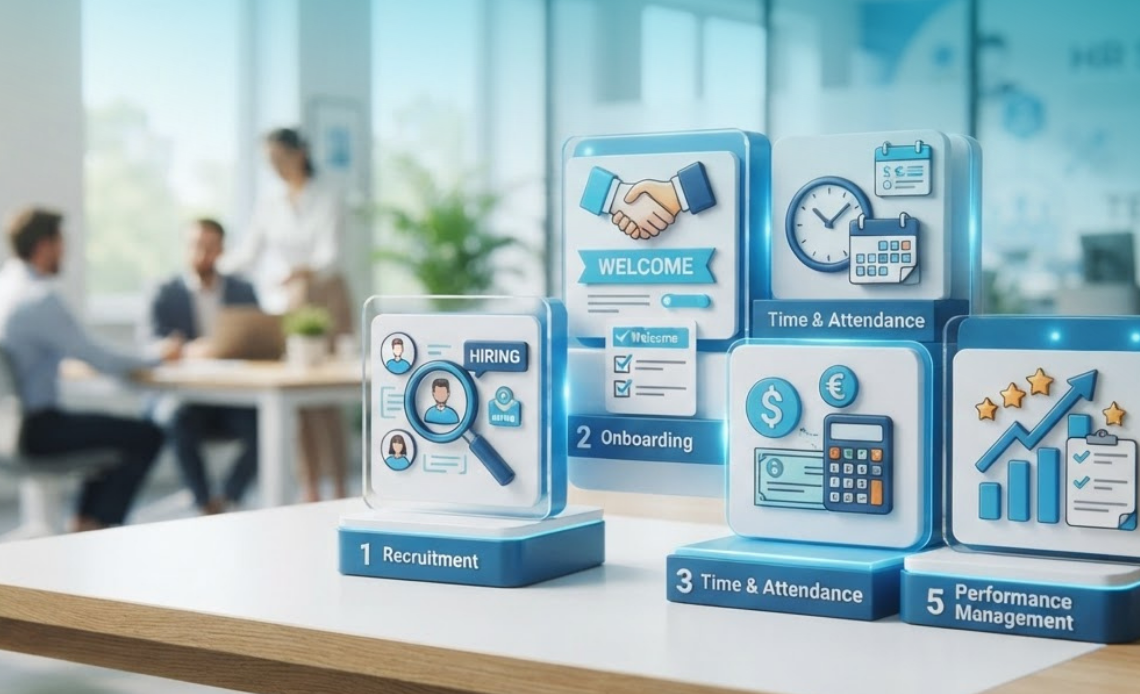
Recruiting and Onboarding
Beyond core administrative functions, many HRMS platforms include recruiting and applicant tracking tools, letting HR teams post job openings, screen candidates, and manage the hiring pipeline from a single system. Once a candidate is hired, the same platform typically handles digital onboarding, letting new employees complete paperwork, review policies, and set up their accounts before their first day.
Performance Management and Learning
Most modern human resource management system (hrms) suites also include performance management tools, goal setting, review cycles, and feedback tracking, along with learning and development modules for training and skill tracking. These talent-focused functions are what historically distinguished a full HRMS from a more basic HRIS focused purely on data storage.
Chapter 4 : Time, Attendance, and Self-Service Modules
Time Tracking and Leave Management
Time and attendance tracking is another near-universal HRMS function, covering clock-ins, shift scheduling, overtime calculations, and leave requests. This module typically integrates directly with payroll, so approved time off or logged hours flow automatically into the next pay run without manual re-entry.
The Role of Employee Self-Service Inside an HRMS Human Resource Management Systems
Employee self-service is usually built directly into an HRMS rather than sold as a separate product, giving employees a portal to check pay stubs, request time off, and update their own personal information without routing every request through HR. This self-service layer is often what determines how much administrative time an HRMS actually saves in daily practice, since it shifts routine, repetitive requests away from HR staff and directly to the employees who need the information.
Chapter 5 : How to Know Which HRMS Modules Your Company Actually Needs
Starting Small vs Buying a Full Suite
Not every company needs every module from day one. A smaller business might only need centralized employee records and payroll to start, while recruiting, learning management, and advanced analytics can wait until headcount and complexity justify the added cost. Buying a full suite upfront can mean paying for modules that sit unused for months, so it’s worth mapping your current pain points before committing to a comprehensive package.
Questions to Ask Before Choosing an HRMS Vendor
Before signing with any vendor, ask which modules are included in the base subscription versus billed as add-ons, how easily the system can scale up as you add modules later, and what implementation support is available for the modules you plan to use first. It’s also worth confirming how data flows between modules, since a system where payroll, time tracking, and employee records don’t sync automatically loses much of the value an HRMS is supposed to provide in the first place.
HRMS vs HRIS vs HCM: Quick Comparison
| Factor | HRIS | HRMS | HCM |
|---|---|---|---|
| Original focus | Employee data storage | Data plus daily HR operations | Data, operations, plus strategic talent management |
| Typical modules | Employee records, basic reporting | Records, payroll, time tracking, self-service | All HRMS functions plus succession planning, advanced analytics |
| Best suited for | Basic record-keeping needs | Most small to mid-sized companies | Larger organizations with strategic workforce planning needs |
| Modern usage | Often used interchangeably with HRMS in vendor marketing | Often used interchangeably with HRIS and HCM | Sometimes reserved for enterprise-grade suites |
Frequently Asked Questions about human resource management system (hrms)
Is HRMS the same thing as human resource management system (hrms) ?
Historically, HRIS referred more narrowly to data storage while HRMS added operational functions like payroll. In current vendor marketing, the terms are frequently used interchangeably, so it’s worth checking a platform’s actual feature list rather than relying on the label alone.
Do all human resource management system (hrms) platforms include talent management, or is that separate?
Most modern HRMS suites include at least basic recruiting, onboarding, and performance management, though the depth of these features varies significantly by vendor and pricing tier.
How many modules does a typical human resource management system (hrms) include?
There’s no fixed number, but common modules include employee records, payroll, benefits, time and attendance, self-service, recruiting, onboarding, and performance management, with some vendors offering additional modules like learning management or advanced analytics.
Is human resource management system (hrms) only for large companies, or can small businesses use it too?
HRMS platforms are used by companies of all sizes. A 2025 survey found that 65% of small businesses in the U.S. already use HR software, with another 15% planning to adopt it within two years, according to HiBob’s HR statistics report, so tiered plans for smaller teams are widely available.
Conclusion
A human resource management system (hrms) isn’t defined by a single feature, it’s the connective layer that ties employee data, payroll, talent management, and daily operations into one coherent platform.
Understanding its core functions, from centralized records to self-service, gives you a clear framework for evaluating any vendor, rather than getting caught up in the terminology debate between HRMS, HRIS, and HCM.
The category itself keeps expanding as a result: industry analysts project the global HR technology market to grow from 40.45 billion dollars in 2024 to 81.84 billion dollars by 2032, according to HiBob’s HR statistics and trends report, reflecting how central HRMS platforms have become to modern workforce management.
Ready to See an human resource management system (hrms) in Action?
The PowerHR brings core HR functions, payroll, talent management, and employee self-service together in one connected HRMS platform. Request a free, personalized demo today and see exactly how each function works before you choose a system for your team.