Introduction
For a long time, HR was seen mostly as an administrative function, payroll, contracts, compliance, important, but not exactly strategic.
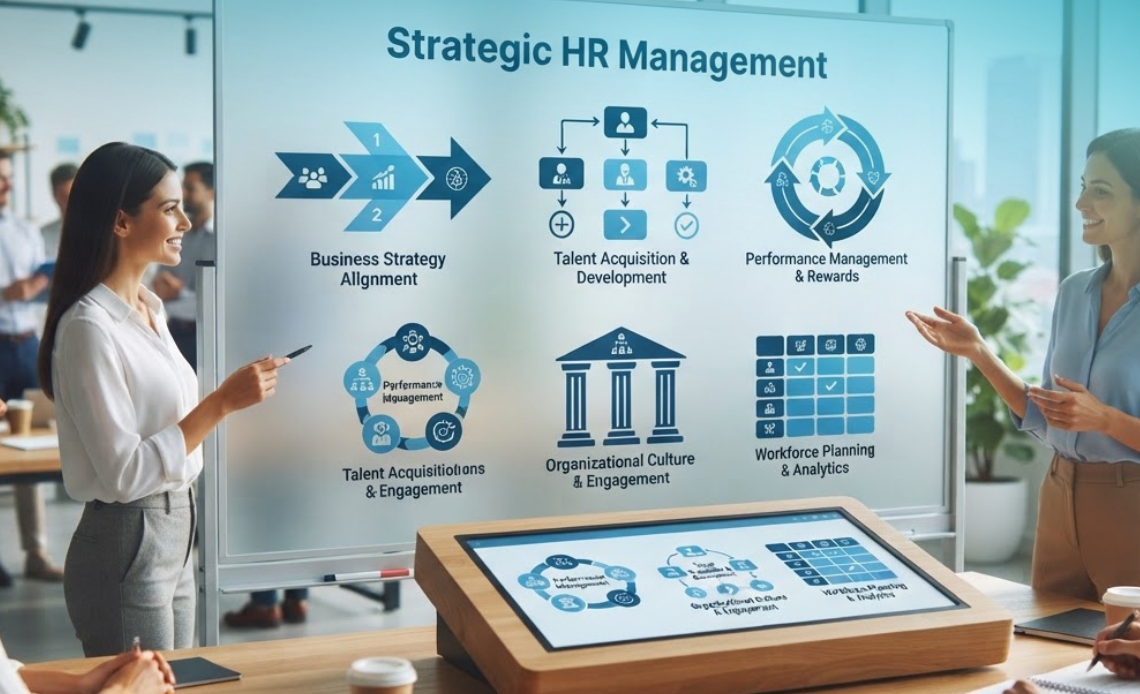
That perception has shifted dramatically. Strategic HR management reframes the HR function as a direct contributor to business performance, not just a support department that keeps the lights on.
But “strategic HR management” isn’t a single technique, it’s an umbrella term that covers several distinct theoretical frameworks, each offering a different lens on how HR should connect to organizational strategy.
Understanding these frameworks isn’t just academic, they shape real decisions about how a company structures its HR function, designs its policies, and measures its own effectiveness. This article introduces five of the most influential frameworks in strategic HR management, what each one emphasizes, and how they differ.
Table of Contents
Framework 1 : The Harvard Model: A Stakeholder-Based Approach to Strategic HR Management
The Four Policy Areas
The Harvard Model, one of the earliest and most influential frameworks in strategic HR management, organizes HR decisions around four core policy areas: employee influence (how much say employees have), HR flow (recruitment, movement, and exit of people through the organization), reward systems, and work systems (how work itself is organized). Rather than treating these as isolated HR functions, the model treats them as interconnected policy choices that together shape organizational outcomes.
Why Stakeholder Interests Matter in Strategic HR Management
What sets the Harvard Model apart is its explicit focus on multiple stakeholders, shareholders, management, employees, unions, and government, rather than assuming HR strategy should serve business strategy alone.
This stakeholder lens makes the Harvard Model particularly useful for organizations operating in heavily regulated industries or contexts where labor relations and social legitimacy matter as much as pure business alignment.
Framework 2 : The Michigan (Matching) Model: Tight Strategic Alignment
The HR Cycle: Selection, Appraisal, Rewards, Development
The Michigan Model, sometimes called the Matching Model, takes a more directly business-driven approach to strategic HR management. It centers on a four-stage HR cycle, selection, appraisal, rewards, and development, and argues that each of these functions should be tightly matched to the organization’s overall business strategy, with minimal deviation.
Strengths and Criticisms of a Purely “Matching” Approach
The strength of this model is clarity: it gives HR leaders a direct, structured way to align every HR decision with strategic priorities. Its most common criticism is that it treats employees somewhat mechanically, as resources to be matched to strategy, with less attention to individual needs, motivation, or the softer human factors that other frameworks, like Harvard’s, take more seriously.
Framework 3 : The Warwick Model: Context and Change in Strategic HR Management
Inner and Outer Context Shaping HR Strategy
The Warwick Model extends earlier frameworks by explicitly incorporating context. It distinguishes between “outer context” (the broader economic, political, technological, and competitive environment) and “inner context” (culture, structure, leadership, and existing HR practices within the organization), arguing that strategic HR management can’t be designed in a vacuum.
Why Context Matters More Than a Fixed Formula
Rather than prescribing a fixed set of best practices, the Warwick Model treats strategic HR management as an ongoing, context-sensitive process of change. This makes it especially relevant for organizations navigating mergers, rapid growth, or significant market disruption, situations where a rigid, one-size-fits-all HR strategy is unlikely to hold up.
Framework 4 : The 5-P Model: From Philosophy to Daily Practice in Strategic HR Management
How the 5 P’s Connect Strategy to Execution
The 5-P Model, developed by Randall Schuler, breaks strategic HR management into five interconnected layers: Philosophy (the guiding beliefs about how people should be managed), Policies (broad guidelines for HR decisions), Programs (coordinated HR initiatives), Practices (roles and behaviors expected of managers and employees), and Processes (how HR activities are formally carried out and communicated).
Applying the 5-P Model in Practice
The value of this framework is that it forces organizations to trace a line from abstract philosophy all the way down to daily execution, so a company’s stated belief in “employee empowerment,” for instance, needs to actually show up in its policies, programs, and day-to-day management practices, not just in a mission statement. This makes the 5-P Model a useful diagnostic tool for spotting gaps between what a company says about its people strategy and what it actually does.
Framework 5 : The Ulrich Model: HR as a Strategic Business Partner
The Four Roles
Dave Ulrich’s model, arguably the most influential in shaping modern strategic HR management practice, defines four distinct roles HR should play: strategic partner (aligning HR with business strategy), change agent (managing organizational transformation), administrative expert (running efficient HR processes), and employee champion (representing employee needs and engagement).
Why This Model Redefined Modern HR’s Identity
Unlike earlier, more academic frameworks, the Ulrich Model directly reshaped how HR departments are structured in practice, giving rise to HR business partner roles that are now standard across large organizations. Its emphasis on HR as a genuine strategic partner, not just an administrative function, is echoed in recent empirical research: a large-scale meta-analysis published in the International Journal of Research and Innovation in Social Science found that strategic HR management has a large, statistically significant positive effect on organizational performance, with an estimated effect size of 0.781 across the studies reviewed.
Comparing the 5 Strategic HR Management Frameworks
| Framework | Primary Focus | Key Strength | Best Suited For |
|---|---|---|---|
| Harvard Model | Multiple stakeholders | Balances social and business legitimacy | Regulated or unionized environments |
| Michigan Model | Tight strategy alignment | Clarity and directness | Performance-driven organizations |
| Warwick Model | Context and change | Adaptability to shifting environments | Organizations facing rapid change |
| 5-P Model | Philosophy to execution | Diagnostic clarity across levels | Auditing gaps between values and practice |
| Ulrich Model | HR as business partner | Practical, widely adopted structure | Most modern corporate HR functions |
How to Apply These Frameworks to Your Own Organization
Few organizations adopt a single framework in its pure textbook form. In practice, most strategic HR management approaches borrow elements from several models at once, using Ulrich’s business partner structure for organizational design, while drawing on the Warwick Model’s context-sensitivity when navigating major change, or the 5-P Model as a diagnostic check on whether stated HR philosophy matches daily practice.
The value of studying these frameworks isn’t memorizing a single “correct” model, it’s building a vocabulary and a set of lenses for diagnosing where your own HR strategy might be misaligned with your broader business goals.
Research consistently supports the underlying premise across all five models: organizations that successfully integrate HR strategy with business objectives report measurably better outcomes, including improved employee engagement, productivity, and financial performance, as documented in a review published in ShodhKosh: Journal of Visual and Performing Arts on aligning strategic HR management with organizational objectives.
Frequently Asked Questions abour HR strategic Management
What is strategic HR management in simple terms?
Strategic HR management is the practice of designing and running HR functions, recruitment, development, rewards, and policy, in direct alignment with an organization’s broader business goals, rather than treating HR as a purely administrative function.
Which strategic HRM model is most used today?
The Ulrich Model is arguably the most widely adopted in practice, having directly shaped the modern HR business partner structure used across many large organizations.
Can a company combine multiple frameworks at once?
Yes, and in practice most organizations do. Frameworks like Ulrich’s structural model, Warwick’s context-sensitivity, and the 5-P Model’s diagnostic approach are often used together rather than in isolation.
What's the difference between HRM and strategic HR management?
Traditional HRM tends to focus on administrative and operational HR tasks, while strategic HR management explicitly ties those same functions to long-term business strategy and organizational performance outcomes.
Conclusion
Strategic HR management isn’t a single technique, it’s a family of frameworks, each offering a different way of thinking about how people management connects to business success.
The Harvard, Michigan, Warwick, 5-P, and Ulrich models each highlight a different piece of that puzzle, stakeholders, alignment, context, execution, and organizational role, and understanding all five gives HR leaders a far richer toolkit than relying on just one.
Turn Strategic HR Theory Into Practice
The PowerHR gives HR teams the operational foundation to put strategic HR management into practice, from centralized data to performance tracking and workforce analytics. Request a free, personalized demo today and see how the right platform can support your organization’s HR strategy.